RIP Claude Fable, open-source AI unleashed, full body avatars, new Google models, new TTS: AI NEWS

First-person world simulator driven by 3D human motion plus anchor views, rendering egocentric video including object interactions. Code under review.


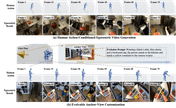
Research framework for first-person world simulation driven by 3D human motion and anchor-view scene customization.
Updated EU status checked Last shown
Sources: the vendor's own pages (linked above) and creator videos at the linked timestamps. EU status is information, not legal advice; see how we check.
AnchorWorld is a research framework from an internship at the Kling Team, Kuaishou Technology, for egocentric (first-person) interactive world simulation. It uses 3D human motion as the action signal, so an agent or player can navigate and interact with a generated world, and it renders the result as first-person video, including object interactions.
To handle body parts that are out of view in first-person footage, it adds third-person video as auxiliary training supervision, using a projection-based action representation that combines full-body motion with camera trajectories. The model is pre-trained on third-person videos and then adapted to the egocentric viewpoint.
World customization works through anchor views. Each anchor view has an RGB image for appearance, a 3D pose for spatial grounding, and an evolution prompt describing how the local scene changes over time. These are injected into a pre-trained video model without architectural changes: in-context image tokens, pose embeddings, and masked cross-attention for the prompts.
The project page compares it against PlayerOne (re-implemented on Wan2.2 TI2V 5B) and CaM. At the time of the source material, code was reported to be under review, and no weights or public demo were listed. Hand poses are excluded because their estimation from egocentric data is unreliable.
Watch the moment: the exact second top creators show it. Videos load only when you press play, via youtube-nocookie.com.
First-person world simulator driven by 3D human motion plus anchor views, rendering egocentric video including object interactions. Code under review.
Closest neighbours by meaning, not just by category.
Research
Research method that builds controllable, articulated 3D object models from keypoints, point clouds or depth video.

Model
Research framework that conditions one video world model on force, camera, hand pose and robot pose actions.

Model
World model that turns a few context images into an editable, physics-simulated 3D world rendered by a video model.
Model
Research framework that turns the Minimax H3 video generator into an interactive world model controlled by key presses.

Model
Real-time interactive world model with compressed memory and hybrid action and semantic control, built on Wan 2.2.
Research
Research system that turns a single image into a 360° Gaussian scaffold and renders interactive video at 8 FPS.