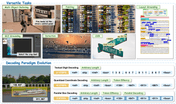
Vision-language grounding model that detects and segments objects in images/video using parallel box decoding, predicting whole bounding boxes in one step. Trained on 103M queries and 785M boxes; 3B params, 7.8 GB, code and training released.
Nvidia vision-language model for object detection and visual grounding that decodes whole bounding boxes in parallel.
Updated EU status checked Last shown
LocateAnything at a glance
- What is LocateAnything?
- LocateAnything is a model from Nvidia. Nvidia vision-language model for object detection and visual grounding that decodes whole bounding boxes in parallel.
- Who makes LocateAnything?
- LocateAnything is made by Nvidia.
- Does LocateAnything work in the EU?
- Available in the EU. Research model with publicly released code, training and dataset per creator and project page, so it can be downloaded and run anywhere; no EU restriction found, though the license was not confirmed. Last verified 14 Nov 2026.
- How much does LocateAnything cost?
- Open source. Research release; code, training and dataset reportedly public. Licence terms not confirmed.
- Where was LocateAnything shown?
- In 1 creator video by AI Search. Most recently by AI Search on 31 May 2026, at 1:01 in “Self-improving AI, Opus 4.8, Nvidia bangers, game-ready 3D models, juggling robots: AI NEWS”.
Sources: the vendor's own pages (linked above) and creator videos at the linked timestamps. EU status is information, not legal advice; see how we check.
LocateAnything is a unified generative grounding and detection framework from Nvidia Research. It uses Parallel Box Decoding (PBD), which treats each bounding box or point as one atomic unit and predicts the full coordinate set (x1, y1, x2, y2) in a single step. This replaces token-by-token coordinate generation, which the authors say mismatches box geometry and limits inference speed.\n\nThe architecture combines a Moon-ViT vision encoder and a Qwen2.5 language decoder, joined by an MLP projector, and processes images at native resolution. It offers three inference modes: Fast (parallel prediction), Slow (autoregressive coordinate decoding for stability), and Hybrid (fast by default, falling back to slow when format irregularity or spatial ambiguity is detected). On a single H100 in Hybrid Mode, the project page reports 12.7 boxes per second, versus 1.1 for Qwen3-VL and 5.0 for Rex-Omni.\n\nIt is trained on LocateAnything-Data, which covers about 138M queries and 785M boxes over 12M images. The data spans general object detection, GUI element grounding, referring comprehension, OCR text localization, layout grounding and point localization. Creator coverage describes a 3B-parameter model with released code and training. Intended uses include dataset labeling, document and GUI understanding, and latency-constrained settings such as robotics. The license and exact release links were not given in the provided material.

- Parallel Box Decoding: predicts a full box or point in one step
- Fast, Slow and Hybrid inference modes
- Reported 12.7 boxes/s on one H100 in Hybrid Mode
- Trained on LocateAnything-Data (138M queries, 785M boxes)
- Covers object detection, GUI grounding, OCR, layout and point localization
- Moon-ViT encoder with Qwen2.5 decoder
As seen on YouTube
Watch the moment: the exact second top creators show it. Videos load only when you press play, via youtube-nocookie.com.
Similar AI tools
Closest neighbours by meaning, not just by category.
WeVisOne-VL
Model · Tencent
Tencent's Qwen3-VL-based model unifying detection, pointing, OCR, segmentation and alpha matting in one VLM.
FixAnything
Model
Video-diffusion LoRA that repairs artifacts in 3DGS, NeRF, mesh and point-cloud renders while keeping the camera path.
NVIDIA Nemotron 3.5 Super VL
Model · NVIDIA
NVIDIA's open multimodal model (120B total, 12B active parameters) for image, video and document understanding.
Nemotron
Model · Nvidia
NVIDIA's family of open models for agentic AI: reasoning, vision, speech, retrieval and safety models.
SageAttention
Library
Windows-wheel fork of SageAttention, a quantized attention kernel library that speeds up diffusion and video model inference.
Mirage
Model · Cactus Compute
Tiny ~51M-parameter vision model from Cactus Compute for on-device object detection, text reading and spatial understanding.