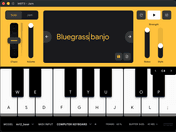
Open-source real-time music generator controllable live via MIDI, audio and text. Latency drops to ~200ms from 3s, 2.4B parameters, runs on a MacBook, aimed at DAW plugin use.
Open-weights 2.4B live music model from Google controllable via MIDI, audio and text, running locally on Apple Silicon.
Updated EU status checked Last shown
Magenta RealTime 2 at a glance
- What is Magenta RealTime 2?
- Magenta RealTime 2 is a model from Google. Open-weights 2.4B live music model from Google controllable via MIDI, audio and text, running locally on Apple Silicon.
- Who makes Magenta RealTime 2?
- Magenta RealTime 2 is made by Google.
- Does Magenta RealTime 2 work in the EU?
- Available in the EU. Open weights and apps are downloadable and run locally with no region restriction mentioned on the official page; the only stated requirement is Apple Silicon hardware. Last verified 14 Nov 2026.
- How much does Magenta RealTime 2 cost?
- Open source. Open-weights model and apps are free to download; runs locally on Apple Silicon MacBooks.
- Where was Magenta RealTime 2 shown?
- In 1 creator video by AI Search. Most recently by AI Search on 7 Jun 2026, at 7:07 in “Full body waifus, AI dreams, realtime AI music, open-source Gemini Omni: AI NEWS”.
Sources: the vendor's own pages (linked above) and creator videos at the linked timestamps. EU status is information, not legal advice; see how we check.
Magenta RealTime 2 (MRT2) is an open-weights live music generation model from Google's Magenta team, with 2.4B parameters in its base size and a 230M small variant. Unlike offline prompt-to-track generators, it streams audio continuously and responds to control input in real time. It is a codec language model over SpectroStream audio tokens, with MIDI and style prompts (text or audio, embedded via MusicCoCa) injected as frame-aligned conditioning at each step.
Control latency is about 200 ms, compared with about 3 s for the first Magenta RealTime, and the model supports MIDI in addition to text and audio control. It uses causal sliding-window attention for continuous streaming with bounded memory. Google also releases a C++ inference engine built on MLX, an open-source Python library (pip install magenta-rt, JAX/MLX), and example apps and plugins for standalone use or DAW integration.
It targets musicians and developers building instruments and software integrations. Real-time streaming needs an Apple Silicon MacBook: the base model needs an M3 Pro or better, or an M2 Max or better, while the small model runs on any Apple Silicon MacBook including the Air. Other Apple Silicon Macs can run offline, non-real-time inference. Finetuning and more example apps are announced as coming later.

- ~200 ms control latency with 40 ms frames
- Control via MIDI, audio and text prompts
- 2.4B base and 230M small model sizes
- Local C++ inference engine using MLX on Apple Silicon
- Open-source Python library (magenta-rt) with JAX/MLX
- Example standalone apps and DAW plugins
As seen on YouTube
Watch the moment: the exact second top creators show it. Videos load only when you press play, via youtube-nocookie.com.
Similar AI tools
Closest neighbours by meaning, not just by category.
MAGI-2
Model · Sand AI
Open-weights 114B MoE model from Sand AI that generates synchronized video and audio from text or image prompts.
Foundation 1
Model
Open-source local AI model for generating music loops, with reference-loop stacking and MIDI conversion.
Lyria 3.5
Model · Google
Google DeepMind's music generation model producing vocal tracks up to 3 minutes from text or image prompts.
YuE2
Model · Multimodal Art Projection (M-A-P)
Open-weights music generator that plans an editable ABC-style score, then renders full songs with vocals and accompaniment.
Suno
App · Suno
AI music generator that creates full songs with vocals and instrumentation from text prompts or lyrics.
Stable Audio 3
Model · Stability AI
Stability AI's family of text-to-audio models for music and SFX, with open-weight Small and Medium variants and an API-only Large.