Skip to content
latestai.eulatestai.eu
AC

AI co-scientist

by Google DeepMind

Gemini-based multi-agent system from Google that generates, debates and ranks scientific hypotheses for researchers.

Updated EU status checked Last shown

AI co-scientist at a glance

What is AI co-scientist?
AI co-scientist is an agent from Google DeepMind. Gemini-based multi-agent system from Google that generates, debates and ranks scientific hypotheses for researchers.
Who makes AI co-scientist?
AI co-scientist is made by Google DeepMind.
Does AI co-scientist work in the EU?
Unverified. No explicit evidence found. Last verified 14 Nov 2026.
How much does AI co-scientist cost?
Pricing unknown. No pricing or general-availability details in the provided material.
Where was AI co-scientist shown?
In 2 creator videos by AI Search. Most recently by AI Search on 28 May 2026, at 0:54 in “The acceleration is here!”.

Sources: the vendor's own pages (linked above) and creator videos at the linked timestamps. EU status is information, not legal advice; see how we check.

About

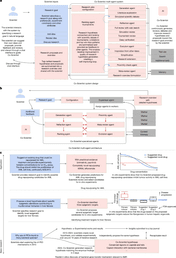
Co-Scientist (AI co-scientist) is a multi-agent AI system built on Google's Gemini, designed to support scientists in generating research hypotheses and experimental protocols. Given a research goal in natural language, it searches and reasons over literature, proposes hypotheses, and cites relevant sources. It is described in a Nature paper, "Accelerating scientific discovery with Co-Scientist".

A Supervisor agent parses the goal and allocates resources to specialised worker agents (Generation, Reflection, Ranking, Evolution, Proximity and Meta-review) through an asynchronous task queue. Hypotheses are debated and ranked in a tournament, and feedback from the tournament drives iterative improvement. Test-time compute scaling is reported to improve hypothesis quality over time. It uses tools such as web search and specialised AI models, and scientists can steer it through a conversational interface.

Validation focused on three biomedical applications: drug repurposing and synergistic combination therapies for acute myeloid leukaemia (confirmed in vitro in AML cell lines), novel epigenetic targets for liver fibrosis, and mechanisms of antimicrobial resistance, where it independently recapitulated an unpublished discovery. Although described as general-purpose, the published evidence is biomedical. The provided material does not state public access terms, pricing or a general release; its outputs are hypotheses that require experimental verification.


Key features
  • Multi-agent architecture with Supervisor and Generation, Reflection, Ranking, Evolution, Proximity and Meta-review agents
  • Tournament-based evolution of hypotheses with self-improving feedback loop
  • Asynchronous task execution for flexible test-time compute scaling
  • Literature search and citation grounding, with web search and specialised AI model tools
  • Scientist-in-the-loop natural language interface for goals, constraints and feedback
  • Validated in vitro on AML drug repurposing and combination therapies
2 moments

As seen on YouTube

Watch the moment: the exact second top creators show it. Videos load only when you press play, via youtube-nocookie.com.

AI
AI Search28 May 2026
The acceleration is here!

Multi-agent system (supervisor, generation, reflection, proximity, evolution, ranking agents) that generates and Elo-ranks scientific hypotheses via simulated debates. It beat other AI models and human experts in blind tests, and its drug repurposing suggestions for AML, liver fibrosis and antibiotic resistance mechanisms were validated in lab experiments.

Keep exploring

Similar AI tools

Closest neighbours by meaning, not just by category.