Skip to content
latestai.eulatestai.eu

FutureHouse multi-agent system that automates hypothesis generation and data analysis for experimental biology.

Updated EU status checked Last shown

Robin at a glance

What is Robin?
Robin is an agent from FutureHouse. FutureHouse multi-agent system that automates hypothesis generation and data analysis for experimental biology.
Who makes Robin?
Robin is made by FutureHouse.
Does Robin work in the EU?
Unverified. No explicit evidence found. The provided pages are a Nature research article with no supported-countries list or regional restrictions. Last verified 14 Nov 2026.
How much does Robin cost?
Open source. Code is reported as available on GitHub; no pricing information was provided. Running it requires LLM API access and lab work, whose costs are not specified.
Where was Robin shown?
In 1 creator video by AI Search. Most recently by AI Search on 28 May 2026, at 21:16 in “The acceleration is here!”.

Sources: the vendor's own pages (linked above) and creator videos at the linked timestamps. EU status is information, not legal advice; see how we check.

About

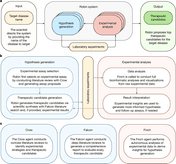
Robin is a multi-agent system from FutureHouse, described in a Nature paper titled "A multi-agent system for automating scientific discovery". It combines literature search agents with data analysis agents in a lab-in-the-loop workflow. The system generates hypotheses, proposes experiments, interprets experimental results and produces updated hypotheses. Wet-lab work and some steps, such as read demultiplexing and alignment, are performed by humans.

The component agents are Crow (literature review), Falcon (deep reports) and Finch (data analysis). In the paper, Robin was applied to dry age-related macular degeneration. It proposed enhancing retinal pigment epithelium phagocytosis as a strategy. It identified ripasudil, a Rho kinase inhibitor, and KL001 as candidates with in vitro efficacy. A follow-up RNA-seq experiment analysed by Finch showed upregulation of ABCA1, which the authors suggest is a possible novel target. A YouTube creator reported figures of under 2 hours and about $10.76 of compute, against an estimated 400 human hours. These figures are not confirmed in the provided paper text.

The authors state current limits. Robin produces experimental outlines rather than precise executable protocols. Finch relies on prompt engineering. Results are in vitro only. The paper refers to a Robin GitHub repository with the code, including prompts. The URL was not in the provided material. Access is mainly through the paper and the released code, aimed at researchers.


Key features
  • Closed-loop hypothesis generation, experiment proposal, data analysis and hypothesis refinement
  • Crow agent for literature review and Falcon agent for deep reports
  • Finch agent for data analysis, e.g. differential gene expression
  • Applied to dry AMD: in vitro validation of ripasudil and KL001
  • Code released on GitHub per the paper's Code availability section
1 moment

As seen on YouTube

Watch the moment: the exact second top creators show it. Videos load only when you press play, via youtube-nocookie.com.

AI
AI Search28 May 2026
The acceleration is here!

Closed-loop multi-agent system for automating scientific discovery, with Crow (literature review), Falcon (deep reports) and Finch (data analysis, eight parallel instances with consensus). It proposed and validated treatments for dry macular degeneration (Y27632, ripasudil, KL001), taking under 2 hours and about $10.76 compute versus an estimated 400 human hours.

Keep exploring

Similar AI tools

Closest neighbours by meaning, not just by category.