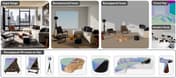
Turns a single image into a 3D scene with each object as its own mesh, processing the whole scene at once. Supports automatic, point and mask modes; code, training code and dataset released.

CoLa3D
Research model that decomposes a single image or scene mesh into object-level 3D meshes with consistent spatial layout.
Updated EU status checked Last shown
CoLa3D at a glance
- What is CoLa3D?
- CoLa3D is a model. Research model that decomposes a single image or scene mesh into object-level 3D meshes with consistent spatial layout.
- Does CoLa3D work in the EU?
- Unverified. No explicit evidence found. Last verified 14 Nov 2026.
- How much does CoLa3D cost?
- Pricing unknown. Research project; no pricing information found. Code reportedly released.
- Where was CoLa3D shown?
- In 1 creator video by AI Search. Most recently by AI Search on 8 Nov 2026, at 25:32 in “Weight space programming, new 3D models, Gemini Omni 1.2, GPT Image 2.6: AI NEWS”.
Sources: the vendor's own pages (linked above) and creator videos at the linked timestamps. EU status is information, not legal advice; see how we check.
CoLa3D (Composable Latent 3D Decomposition) is a research method accepted at NeurIPS 2026. It decomposes a single whole-scene 3D latent into object-level meshes that keep a consistent spatial layout. The input can be a single image or an existing scene mesh.
According to a YouTube creator summary, the model processes the whole scene at once rather than object by object, and each object is output as its own mesh. It reportedly supports automatic, point-prompt and mask-prompt modes. The same source says code, training code and a dataset have been released, but no repository links were available in the provided material, so this is unverified.
The project page offers interactive results and comparisons with state-of-the-art methods, plus downstream applications. It is aimed at researchers and developers working on scene-level 3D generation and editing. The authors are Xudong Cai, Yongcai Wang, Deying Li and Chuanxia Zheng.

- Decomposes a whole-scene 3D latent into per-object meshes
- Input: single image or existing scene mesh
- Consistent spatial layout across objects
- Automatic, point and mask selection modes (per creator report)
- Code, training code and dataset reportedly released
As seen on YouTube
Watch the moment: the exact second top creators show it. Videos load only when you press play, via youtube-nocookie.com.
Similar AI tools
Closest neighbours by meaning, not just by category.
TriSplat
Model
Feed-forward 3D scene reconstruction model that outputs triangle primitives directly usable as meshes for simulation.
Fire3D
Model
Feed-forward system that turns an RGB image or video into editable, textured per-object 3D meshes in under a minute.
T3lescope
Research · Preferred Networks
Generative method from Preferred Networks that reconstructs high-resolution 3D scene meshes from posed multi-view images.
World Sculpt
Model
Research framework that turns posed images with instance masks and 3D boxes into per-object meshes for cluttered scenes.
VoxLution
Model
Research model generating 3D indoor scenes as sparse voxels, refined from 25 cm to 1.5625 cm by an autoregressive cascade.
GenRecon
Research
Research method that reconstructs PBR-ready indoor 3D scene meshes from multi-view images using a Trellis.2 generative prior.