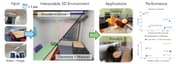
Reconstructs simulation-ready 3D scenes from photos or video, with each object as its own mesh with materials. Runs in under a minute and handles 16 objects in parallel on one GPU; code and training code released.
Feed-forward system that turns an RGB image or video into editable, textured per-object 3D meshes in under a minute.
Updated EU status checked Last shown
Fire3D at a glance
- What is Fire3D?
- Fire3D is a model. Feed-forward system that turns an RGB image or video into editable, textured per-object 3D meshes in under a minute.
- Does Fire3D work in the EU?
- Unverified. No explicit evidence found. It is an academic research project with no stated regional restrictions, and the license was not provided. Last verified 14 Nov 2026.
- How much does Fire3D cost?
- Open source. Research project; code reportedly released (per a YouTube review), no pricing listed.
- Where was Fire3D shown?
- In 1 creator video by AI Search. Most recently by AI Search on 13 Sept 2026, at 9:30 in “New Deepseek, human genome map, Navier Stokes, GPT finance, Suno v6, YuE2: AI NEWS”.
Sources: the vendor's own pages (linked above) and creator videos at the linked timestamps. EU status is information, not legal advice; see how we check.
Fire3D (FIRE3D: Feed-forward Interactive 3D Scene Reconstruction) is a research framework from the University of Illinois Urbana-Champaign and Cornell University. From an unsegmented RGB image or casual video, it detects the objects in a scene, estimates their 6-DoF poses and oriented boxes, and reconstructs each one as a complete textured mesh with PBR appearance. A static background instance holds structural surfaces.
The pipeline uses Pi3X to estimate point maps and camera poses, lifts DINOv3 features into a shared 3D representation, and then completes each entity with structure, shape and material flows. It builds on the TRELLIS.2 SC-VAE and adds HC-VAE, a second hierarchical compression stage (32× smaller latent) that lets up to 16 objects be processed in parallel on one GPU. Generation uses a fixed 12-step flow-sampling schedule and no test-time optimization. The authors report up to twelve textured instances in under a minute, including preprocessing.
The outputs are amodally complete, independently editable assets intended for games and interactive applications. According to the project page, it reports leading detection accuracy on perception benchmarks and competitive rendering quality, compared with systems such as ShapeR and SAM 3D Objects. A YouTube review states that code and training code have been released, but no repository link was in the provided material.

- Single RGB image or casual video as input, with no supplied masks, boxes or poses
- Predicts object count, 3D masks, oriented boxes and 6-DoF poses
- Per-object amodal meshes with PBR textures plus a background instance
- No test-time optimization; up to twelve textured instances in under a minute
- HC-VAE gives 32× latent compression, enabling up to 16 objects in parallel on one GPU
- Interactive 3D explorer on the project page for inspecting and editing reconstructions
As seen on YouTube
Watch the moment: the exact second top creators show it. Videos load only when you press play, via youtube-nocookie.com.
Similar AI tools
Closest neighbours by meaning, not just by category.
TriSplat
Model
Feed-forward 3D scene reconstruction model that outputs triangle primitives directly usable as meshes for simulation.
CoLa3D
Model
Research model that decomposes a single image or scene mesh into object-level 3D meshes with consistent spatial layout.
InfiniSplat v2
Model
Feed-forward 3D Gaussian Splatting model that reconstructs scenes from arbitrary input views, with or without camera poses.
PURE
Research
Post-training method that refines feed-forward 3D reconstruction models (Pi3, DA3, VGGT) on unlabeled video.
Lucida
Research · ByteDance
ByteDance research pipeline that turns indoor captures into editable, simulation-ready 3D scenes of separate object meshes.
World Sculpt
Model
Research framework that turns posed images with instance masks and 3D boxes into per-object meshes for cluttered scenes.