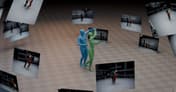
Markerless multi-person motion capture from multi-view video, recovering pose, shape, and hands of each person even in close contact. Trained on the Mamma-Syn synthetic dataset of 2.5M crops; code released.

Mamma
Markerless multi-person motion capture that recovers SMPL-X body, hands and shape from multi-view video.
Updated EU status checked Last shown
Mamma at a glance
- What is Mamma?
- Mamma is a model. Markerless multi-person motion capture that recovers SMPL-X body, hands and shape from multi-view video.
- Does Mamma work in the EU?
- Unverified. No explicit evidence found. The project page is hosted by a German institute (MPG) with a GDPR privacy policy, but that covers the website only, not model availability or license terms. Last verified 14 Nov 2026.
- How much does Mamma cost?
- Pricing unknown. Research project; no pricing listed. Licensing terms not confirmed in the provided material.
- Where was Mamma shown?
- In 1 creator video by AI Search. Most recently by AI Search on 7 Jun 2026, at 11:30 in “Full body waifus, AI dreams, realtime AI music, open-source Gemini Omni: AI NEWS”.
Sources: the vendor's own pages (linked above) and creator videos at the linked timestamps. EU status is information, not legal advice; see how we check.
MAMMA (Markerless Accurate Multi-person Motion Acquisition) is a research pipeline from the Max Planck Institute for Intelligent Systems (tue.mpg.de domain). It recovers SMPL-X parameters from multi-view RGB video, focusing on two-person interactions, and also handles single-person capture.
The pipeline uses MammaNet, a transformer-based dense landmark estimator (ViT-Base backbone plus a CNN for masks) that predicts 512 2D surface landmarks with uncertainty, visibility and contact probabilities (person-person and floor). Landmarks are matched across views using symmetric epipolar distance and Hungarian assignment, with SAM2 used to track people. SMPL-X is then fitted in several stages, including contact optimization that limits interpenetration.
MammaNet is trained on MammaSyn, a synthetic dataset of 2.5M crops extending BEDLAM, plus BEDLAM data. The authors report lower errors than SMPLify, LookMa and CameraHMR on benchmarks including RICH, Harmony4D, CHI3D and MOYO, and introduce MammaEval-Singles and MammaEval-Dance captured with Vicon. A video creator reports that code has been released, but no repository link or license was in the provided material.

- Recovers SMPL-X pose, shape and hands from multi-view video
- MammaNet predicts 512 dense 2D landmarks with uncertainty, visibility and contact
- Handles close two-person interactions with contact-aware optimization
- Trained on MammaSyn synthetic dataset (2.5M crops)
- Cross-view person matching via epipolar distance and SAM2 tracking
As seen on YouTube
Watch the moment: the exact second top creators show it. Videos load only when you press play, via youtube-nocookie.com.
Similar AI tools
Closest neighbours by meaning, not just by category.
Mobius
Model
Unified motion-language model for text-to-motion, motion captioning, completion and editing, from HKUST and Tencent Games.
MSFlow
Model
Text-to-human-motion flow-matching model that generates full-resolution motion directly, with training-free joint constraints.
VideoMDM
Research
Diffusion framework that learns text-to-3D human motion generation from 2D poses extracted from monocular videos.
FlowHMR
Model
Monocular video motion capture that combines flow matching with physics-based RL for plausible 3D human motion.
MiniMax-H3-Realism-People-LoRA
Model · fal
LoRA adapter from fal for MiniMax H3 that targets realistic people, faces and natural skin in text/image/reference-to-video.
Actionable World Representation
Research
Research method that builds controllable, articulated 3D object models from keypoints, point clouds or depth video.