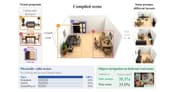
Generates complete 3D rooms with sensible furniture layouts from text, using zones and Flux for furniture images. Code, LoRA adapters and 3D asset library released.

SceneBloom
Research framework that generates collision-free, physically stable 3D indoor rooms from diffusion-sampled layouts.
Updated EU status checked Last shown
SceneBloom at a glance
- What is SceneBloom?
- SceneBloom is a research. Research framework that generates collision-free, physically stable 3D indoor rooms from diffusion-sampled layouts.
- Does SceneBloom work in the EU?
- Unverified. No explicit evidence found. Last verified 14 Nov 2026.
- How much does SceneBloom cost?
- Open source. Research project; a video review says code, LoRA adapters and assets were released. No pricing found.
- Where was SceneBloom shown?
- In 1 creator video by AI Search. Most recently by AI Search on 1 Nov 2026, at 4:25 in “AI finally sleeps, Gemini 4 Carbon, ETH cracked, energy-based models, Anthropic IPO: AI NEWS”.
Sources: the vendor's own pages (linked above) and creator videos at the linked timestamps. EU status is information, not legal advice; see how we check.
SceneBloom is a research framework for generating simulation-ready indoor 3D environments for training embodied agents. It combines visual layout sampling with contract-guided 3D compilation. A hierarchical sampler uses diffusion priors to produce furniture arrangements within functional zones. A compiler then uses relations extracted from each proposal to guide geometric fitting and local pose correction.
The authors report evaluations across five room types (living room, bedroom, dining room, office, bathroom) against Holodeck, SceneWeaver and SAGE. They report the highest visual quality and physical stability among the compared methods. It is the only method with no detected mesh collisions or out-of-bounds objects, and layouts closer to real-room distributions from Matterport3D and Scan2CAD. Generation takes about 2.7 minutes per layout, reported as roughly 27× faster than SAGE.
For downstream use, a SemExp object-navigation policy trained from scratch in SceneBloom houses improved success in held-out real homes from 29.7% to 35.3% on average. The authors say this is 1.7× the gain from training on the same number of real scans. A video review says code, LoRA adapters and a 3D asset library were released, but no repository link was in the provided material. It is aimed at embodied-AI researchers rather than end users.

- Hierarchical diffusion-based furniture layout sampling within functional zones
- Contract-guided 3D compilation with geometric fitting and pose correction
- No detected mesh collisions or out-of-bounds objects in reported tests
- About 2.7 minutes per layout
- Five room types: living room, bedroom, dining room, office, bathroom
- Layouts improved object-navigation transfer to real scans
As seen on YouTube
Watch the moment: the exact second top creators show it. Videos load only when you press play, via youtube-nocookie.com.
Similar AI tools
Closest neighbours by meaning, not just by category.
GenRecon
Research
Research method that reconstructs PBR-ready indoor 3D scene meshes from multi-view images using a Trellis.2 generative prior.
VoxLution
Model
Research model generating 3D indoor scenes as sparse voxels, refined from 25 cm to 1.5625 cm by an autoregressive cascade.
DistScene
Research
Research method that generates compositional 3D scenes from a single image via object-to-scene distillation.
CubePart
Model
Roblox research model that generates text-to-3D objects as separate part meshes from a user-defined part list.
PixWorld
Model
Research model that unifies 3D scene generation and reconstruction in a single pixel-space diffusion model.
Lucida
Research · ByteDance
ByteDance research pipeline that turns indoor captures into editable, simulation-ready 3D scenes of separate object meshes.