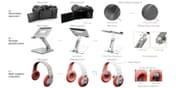
Turns a single image into an interactive 3D model with movable parts and physical behavior, using 3D reconstruction, an agent for part analysis and physics simulation. MIT licensed code released.
Research framework that turns a single image into a textured 3D asset with articulated parts and physical behavior.
Updated EU status checked Last shown
PhysAg3D at a glance
- What is PhysAg3D?
- PhysAg3D is a research. Research framework that turns a single image into a textured 3D asset with articulated parts and physical behavior.
- Does PhysAg3D work in the EU?
- Unverified. No explicit evidence found. It is a research project with a demo page; code is reportedly MIT-licensed, but no repository or regional restrictions were confirmed. Last verified 14 Nov 2026.
- How much does PhysAg3D cost?
- Open source, open source. Research project; code reportedly released under MIT (per a YouTube creator), not verified on official pages. Licence: MIT.
- Where was PhysAg3D shown?
- In 1 creator video by AI Search. Most recently by AI Search on 1 Nov 2026, at 35:12 in “AI finally sleeps, Gemini 4 Carbon, ETH cracked, energy-based models, Anthropic IPO: AI NEWS”.
Sources: the vendor's own pages (linked above) and creator videos at the linked timestamps. EU status is information, not legal advice; see how we check.
PhysAg3D (also referred to as PhysAged) is a research framework from Peking University, Huawei and collaborating institutions. It couples a pretrained 3D generative model with a vision-language agent that uses tools, so that a single image becomes a detailed 3D asset that can also move or deform plausibly.
The agent first infers semantic parts, candidate interactions and physical priors from the image, while a 3D generator separately produces a textured whole-object mesh from the same image. A hierarchical interaction representation links these priors to mechanisms and the mesh surfaces they control. Using geometric and physical tools, the agent builds parts, joints, deformable regions and surface bindings, keeping the generated geometry and materials. Rendered interactions and execution measurements drive revisions within a fixed budget. No joint training is involved, and both rigid articulation and compliant deformation are supported.
The project page shows 223 generated assets with interactive viewers and demonstrations with an open-source Franka Panda robot arm. It reports comparisons with aDSL and PhysX-Omni on real photographs, and an in-the-wild evaluation over 110 predefined semantic actions. A YouTube creator reports MIT-licensed code was released, but no repository link was in the provided material. It is a research manuscript, not a hosted product.

- Single image to textured, interactive 3D asset
- Vision-language agent infers parts, interactions and physical priors
- Supports rigid articulation and compliant deformation
- Budgeted refinement using rendered interactions and execution measurements
- Preserves generated geometry and materials; no joint training
- Demonstrated with Franka Panda robot scenes
As seen on YouTube
Watch the moment: the exact second top creators show it. Videos load only when you press play, via youtube-nocookie.com.
Similar AI tools
Closest neighbours by meaning, not just by category.
PhysX Omni
Model
Research framework generating simulation-ready 3D assets (rigid, deformable, articulated) with physical properties.
PhysiFormer
Model
Diffusion transformer that generates rigid and elastic 3D mesh dynamics in world coordinates from initial velocities and materials.
PixWorld
Model
Research model that unifies 3D scene generation and reconstruction in a single pixel-space diffusion model.
UniForge 3D
Model
Research model that builds complete 3D assets from sparse, unposed images by jointly doing reconstruction and generation.
Fire3D
Model
Feed-forward system that turns an RGB image or video into editable, textured per-object 3D meshes in under a minute.
Pixal3D
Model
Image-to-3D generator from Tsinghua and Tencent ARC Lab that builds meshes pixel-aligned to the input view.